
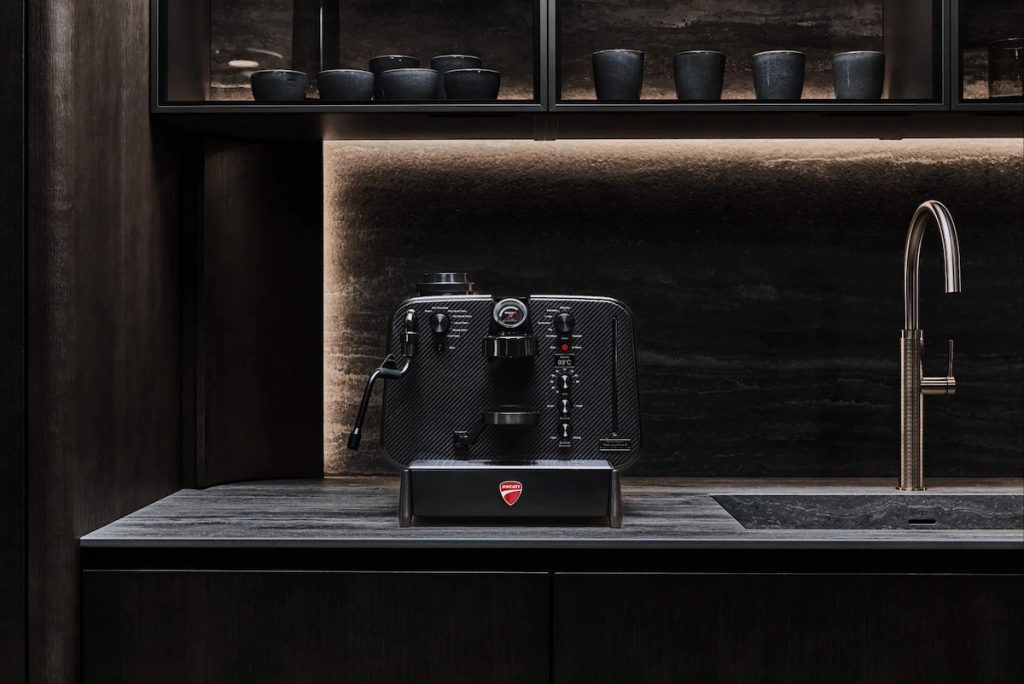
There’s a category of product the watch industry has been making for decades: the centenary edition, sized to a year, priced to the marker rather than the function. The Ducati Barista M3 1926 is what happens when that math gets applied to an espresso machine. One of 1,926 worldwide, €2,599 (about $3,025), available in fall — and before any of the function comes up, real twill-weave carbon fiber, the same composite the company runs on its racing motorcycles at Borgo Panigale.
That last detail is the editorial pivot. At €2,599, the machine has to argue against entry-tier Slayer or mid-La Marzocco equipment — machines that grind whole bean and pull true 9-bar shots from a portafilter. The Ducati Barista M3 1926 doesn’t compete with those on function. It competes on object. The question isn’t whether it brews a great espresso — it’s whether the centenary frame and the material story are worth the premium.
The Ducati Barista M3 1926 as Centenary Object
Ducati turns 100 in 2026. The Borgo Panigale company was founded in 1926, and the entire Spring brand cadence has been built around the centenary moment. The Barista M3 1926 is part of that — explicitly named to the founding year, explicitly produced in an edition of 1,926 units worldwide. The numbering convention is the same one used on limited-edition watches and motorcycles: when the function isn’t the differentiator, the count becomes the contract.
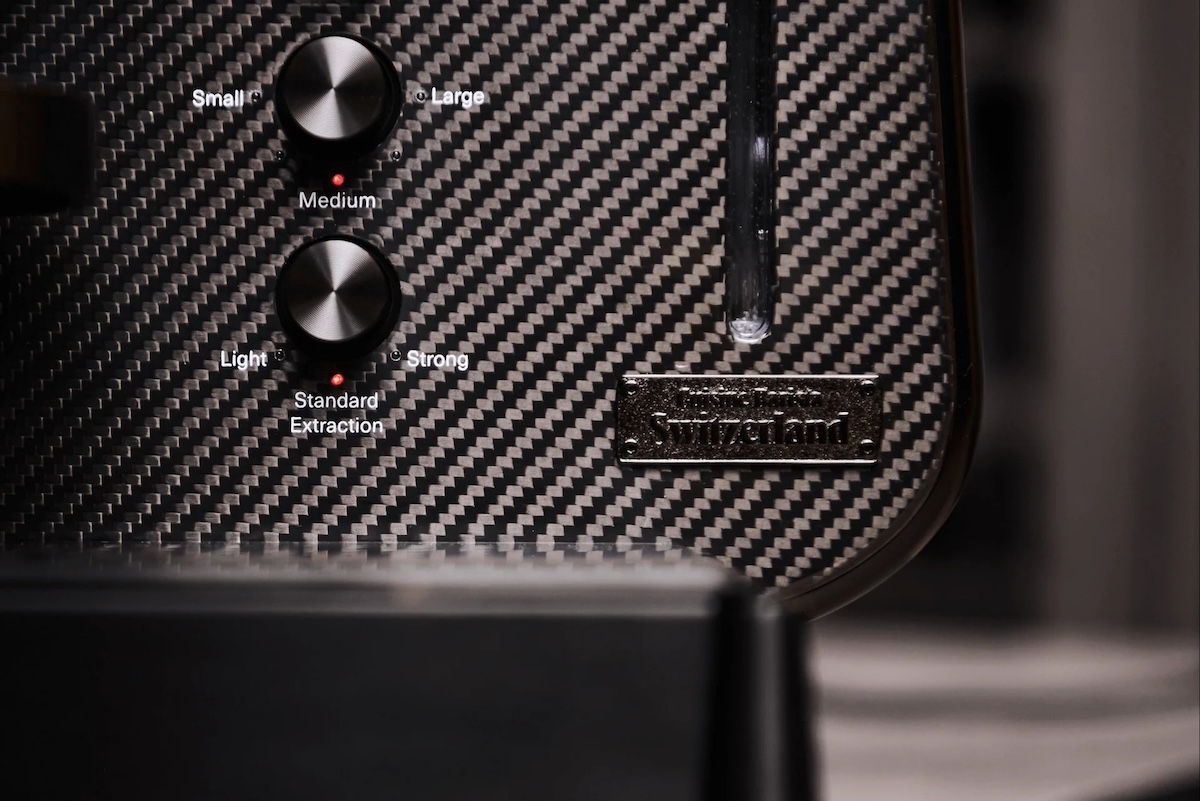
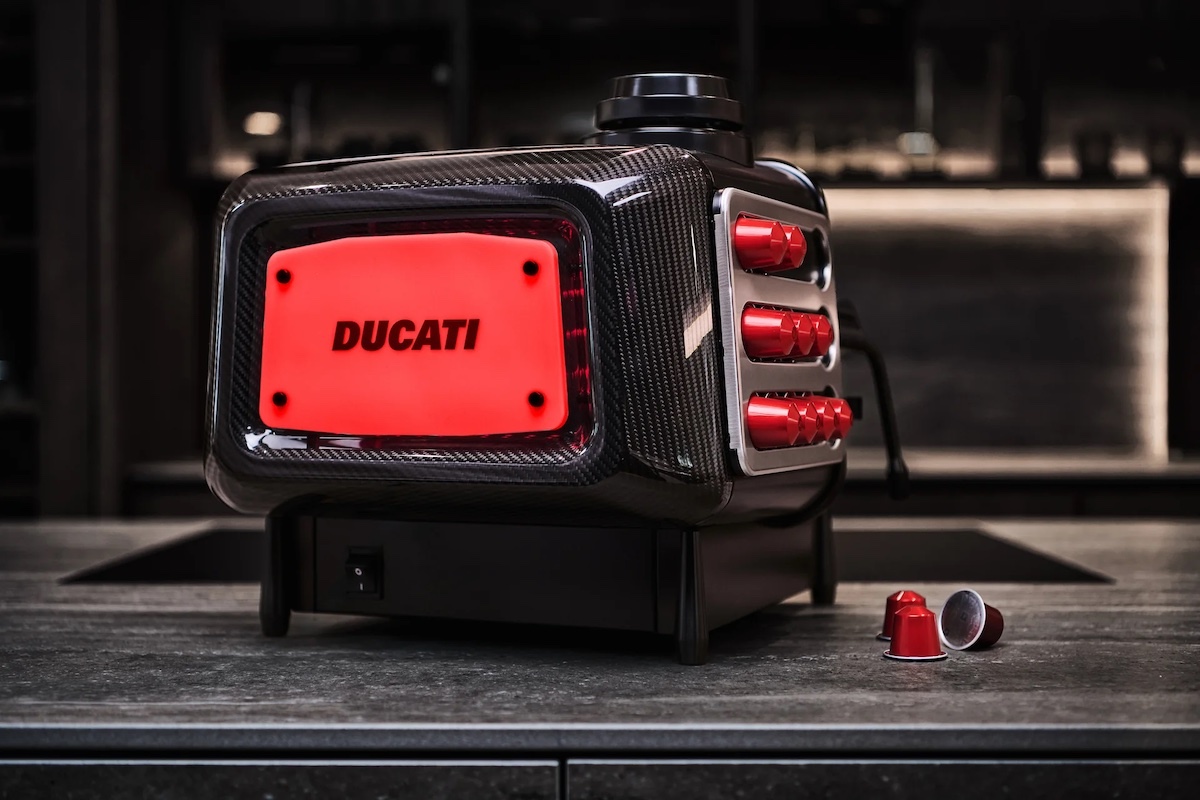
What earns the project its place is the material call. The front and back panels of the Ducati Barista M3 1926 are hand-laid in genuine twill-weave carbon fiber — two 12K cores for structure, a 3K outer skin for the signature diagonal sheen — drawing from the same composite supply chain that feeds the racing machinery at Borgo Panigale. Every other surface is solid stainless steel hardened with a premium PVD coating, the finish that resists fingerprints and stays sharp through daily use. Each unit is hand-assembled.
For the record on provenance: this is a Ducati Motor Holding S.p.A. officially licensed product, built by Cuisine Barista — a premium kitchen-appliance partner, not a licensing-shop operation. The licensing relationship is what makes the project possible at this price; the manufacturing standard is what makes it worth taking seriously.
Inside the Ducati Barista M3 1926 Build
The Ducati Barista M3 1926 is a Nespresso capsule machine. That detail will land differently for different readers. For the espresso purist, it’s a disqualifier; for the buyer who wants twelve drinks at the press of a button and doesn’t have time to dial in a grinder before the first cup of the morning, it’s the entire point. Aluminium capsules work, biodegradable capsules work, and both come from the broadest standardized capsule ecosystem on the market.
What the Ducati Barista M3 1926 brings to that capsule format is engineering that doesn’t typically arrive at this category. A proprietary Thermo-Booster heating system runs a heating surface 250% larger than standard capsule machines, dropping warm-up time to seven seconds — most competitive capsule machines need twenty.
A PID controller holds brewing temperature steady across the cup, with adjustable range from 70°C for delicate green tea to 96°C for fully developed Arabica. Pre-infusion is independently controllable: briefly wet the puck before applying full pressure, then dial in light, standard, or strong extraction profiles by tuning flow rate, pressure, and the temperature curve across the shot.
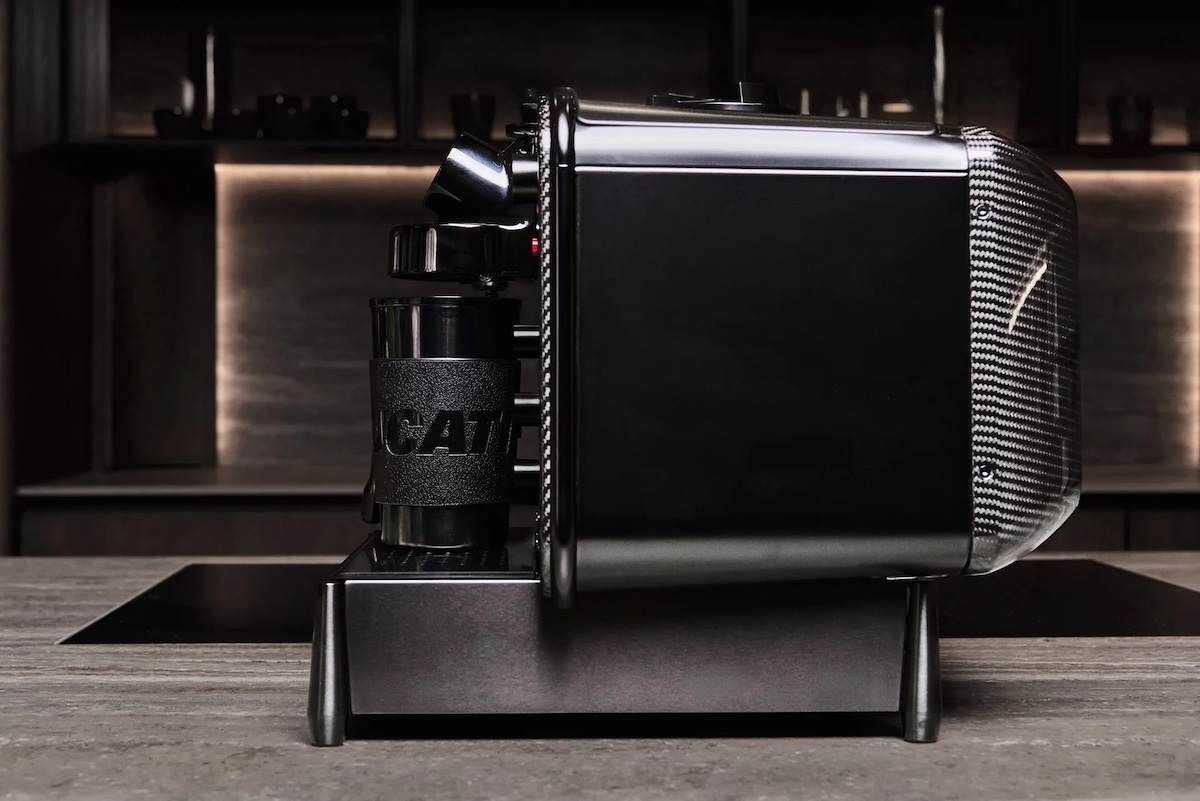
The milk system is where the Ducati Barista M3 1926 gets unusual. There are two milk paths on the same chassis. The in-cup induction frother — billed as a world’s first — heats and froths milk directly inside the included to-go cup, no carafe, no second device, no extra parts to wash. For the buyer who wants barista-level control, a traditional steam wand sits alongside it, stainless steel piped with PVD coating, full control over body and temperature for flat whites, cappuccinos, and latte art.
The everyday details land cleanly. The water tank holds 1.5 litres; the used-capsule bin holds twenty; cup clearance runs from 4 to 14 centimeters, which means everything from a ristretto glass to a travel mug fits under the head. A built-in water filter ships with every machine. The companion app handles descaling guidance, brewing statistics, and custom drink presets.
Where the Ducati Barista M3 1926 Sits at €2,599
Pricing is where the editorial question becomes a real one. The Ducati Barista M3 1926 lists at €2,599. For context, a flagship Nespresso machine from Breville or De’Longhi tops out around $700–800. The Ducati lands roughly four to five times that bracket. Move up the espresso ladder and €2,599 puts a buyer in entry Slayer territory or mid-tier La Marzocco — machines that grind whole bean, pull true 9-bar shots, and reward technique with a different category of cup entirely.
Against that comparison, the Ducati Barista M3 1926 isn’t competing on espresso quality. It’s competing on the same logic that drives the limited-edition reasoning behind pieces like the Bugatti Brouillard — function isn’t the variable, the marker is. The buyer paying €2,599 here isn’t shopping for a better Lattissima. They’re shopping for a centenary object that happens to extract coffee.
Available from fall 2026 in a strict edition of 1,926 units worldwide. Cuisine Barista’s Barista M3 1926 page handles the reservation list directly.
For the buyer who already owns a Panigale, the math writes itself. The same Borgo Panigale carbon fiber that armors the bike now sits on the kitchen counter, marking the same hundred years, in the same edition number as the founding date. That’s not a coffee machine pitch. It’s a centenary object that asks to be on display and brews espresso as a secondary function. Whether that ratio is earned depends on how the Ducati story sits with the buyer — but the engineering inside is real, the material is genuine, and the numbering is honest. 1,926 of these, then never again.
About The Author

You may also like
-
The KATSU TAMASHII Puts a Custom-Knife Grind on a $70 Fixed Blade
-
The Kriega R25 Guy Martin Edition Is the Collaboration Backpack That Has the Miles to Back It Up
-
Hamilton Khaki Navy Scuba Goes Deeper for 2026, Above and Below the Waterline
-
De Bethune 2026—3 New Timepieces From the Geneva Manufacture
-
Tissot Gentleman 38 mm Timepiece